HOME | ABOUT | AUTHOR |HOLOCAUST GENOCIDES | THE GHOUSE DIARY | RELATED SITE
S | FACE BOOK | PHOTO GALLERY | VIDEO GALLERY |

WARNING : This site is not for you if you cannot see the otherness of other and sufferings of both sides of the party in the conflict. Security for Israel and Justice for the Palestinians are interdependent, one will not happen without the other. My view focuses on building cohesive societies where no one has to live in apprehension or fear of the other. I hope and pray a sense of justice to prevail. Amen. Website www.IsraelPalestineDialogue.com | Also Check Israel Palestine Confederation a pragmatic solution

Showing posts with label Israeli Hawks. Show all posts

Saturday, November 26, 2011

How Israel Out-Foxed US Presidents By Morgan Strong

This article reflects the understanding of much of the world on the origins of unrest and its product; terrorism particularly in the Muslim world. The American policy-makers simply do not want to see this; neither the Israeli leaders (not the public) want to acknowledge this. The conflicts continue because it is profitable to that 1% of the greedy in Israel and America, they do not give a rat’s ass about the security for the Israelis or justice for the Palestinians.

If you trace back all the terrorism and conflicts, the invariable catalyst are “injustice to the Palestinians” and “security for the Jews” (not the military, but mental security) the arrogant refusal of our policy makers to see it and find solutions. The conflict has now it escalated and taking roots in countries where there is no reason to be. President Reagan gave a boost to the Talibans and the movie Charlie Wilson’s war was a good expression of the problem we have created.

It is not late, never late to restore justice to the Palestinians and genuine security to the Jews, a lot of fires around the world will extinguish as a consequence to the solution.  Most of the world knows this except the money makers on the blood of Palestinians and Jews alike. It is not about Jews or Palestinians, it is GD business to them and as responsible members of the world community we have to channel these rascals to make peace “their business”. Any ideas without appeasing or losing are welcome.

Mike Ghouse is committed to cohesive societies and offers pluralistic solutions on issues of the day. His work is indexed at www.MikeGhouse.net


# # #
How Israel Out-Foxed US Presidents By Morgan Strong
November 17, 2011

From the Archive: At the G20 summit, French President Nicolas Sarkozy commiserated with President Barack Obama about Israeli Prime Minister Benjamin Netanyahu, whom Sarkozy called a “liar,” prompting Obama to say: “You’re fed up with him? I have to deal with him every day.” But struggling with Israeli leaders is not new, Morgan Strong reported.

By Morgan Strong (Originally published on May 31, 2010)

At the end of a news conference on April 13, 2010, President Barack Obama made the seemingly obvious point that the continuing Middle East conflict – pitting Israel against its Arab neighbors – will end up “costing us significantly in terms of both blood and treasure.”

Obama’s remark followed a similar comment by Gen. David Petraeus on March 16, 2010, linking the unresolved Israeli-Palestinian conflict to the challenges that U.S. troops face in the region.

“The conflict foments anti-American sentiment, due to a perception of U.S. favoritism for Israel,” Petraeus said. “Arab anger over the Palestinian question limits the strength and depth of U.S. partnerships with governments and peoples in the [region] and weakens the legitimacy of moderate regimes in the Arab world.

“Meanwhile, al-Qaeda and other militant groups exploit that anger to mobilize support.”

The truth behind what Obama and Petraeus said is self-evident to anyone who has spent time observing the Middle East for the past six decades. Even the staunchly pro-Israeli Bush administration made similar observations.

Three years ago in Jerusalem, Secretary of State Condoleezza Rice termed the Israeli/Palestinian peace process of “strategic interest” to the United States and expressed empathy for the beleaguered Palestinian people.

“The prolonged experience of deprivation and humiliation can radicalize even normal people,” Rice said, referring to acts of Palestinian violence.

But the recent comments by Obama and Petraeus aroused alarm among some Israeli supporters who reject any suggestion that Israel’s harsh treatment of Palestinians might be a factor in the anti-Americanism surging through the Islamic world.

After Petraeus’s comment, the pro-Israeli Anti-Defamation League said linking the Palestinian plight and Muslim anger was “dangerous and counterproductive.”

“Gen. Petraeus has simply erred in linking the challenges faced by the U.S. and coalition forces in the region to a solution of the Israeli-Arab conflict, and blaming extremist activities on the absence of peace and the perceived U.S. favoritism for Israel,” ADL national director Abraham Foxman said.

However, the U.S. government’s widespread (though often unstated) recognition of the truth behind Petraeus’s comment has colored how the Obama administration has reacted to the intransigence of Israel’s Likud government of Prime Minister Benjamin Netanyahu. (Petraeus later tried to wiggle out of his comment, noting that it was part of his prepared testimony to a congressional committee and that he did not actually speak the words.)

The U.S. government realizes how much it has done on Israel’s behalf, even to the extent of making Americans the targets of Islamic terrorism such as the 9/11 attacks (as the 9/11 Commission discovered but played down) and sacrificing the lives of thousands of U.S. troops fighting in Middle East conflicts.

That was the backdrop for President Obama’s outrage over the decision of the Netanyahu government to continue building Jewish housing in Arab East Jerusalem despite the fact that the move complicated U.S. peace initiatives and was announced as Vice President Joe Biden arrived to reaffirm American support for Israel.

However, another little-acknowledged truth about the U.S.-Israeli relationship is that Israeli leaders have frequently manipulated and misled American presidents out of a confidence that U.S. politicians deeply fear the political fallout from any public battle with Israel.

Given that history, few analysts who have followed the arc of U.S.-Israeli relations since Israel’s founding in 1948 believe that the Israeli government is likely to retreat very much in its current confrontation with President Obama.

Manipulating Eisenhower

In the 1950s, President Dwight Eisenhower was a strong supporter of the fledgling Jewish state and had supplied Israel with advanced U.S. weaponry. Yet, despite Eisenhower’s generosity and good intentions, Israel sided with the British and French in 1956 in a conspiracy against him.

Israeli leaders joined a secret arrangement that involved Israel invading Egypt’s Sinai, which then allowed France and Great Britain to introduce their own forces and reclaim control of the Suez Canal.

In reaction to the invasion, the Soviet Union threatened to intervene on the side of Egypt by sending ground troops. With Cold War tensions already stretched thin by the crises in Hungary and elsewhere, Eisenhower faced the possibility of a showdown between nuclear-armed adversaries.

Eisenhower demanded that the Israeli-spearheaded invasion of the Sinai be stopped, and he brought financial and political pressures to bear on Great Britain and France.

A ceasefire soon was declared, and the British and French departed, but the Israelis dragged their heels. Eisenhower finally presented Israeli Prime Minister David Ben-Gurion with an ultimatum, a threat to cut off all U.S. aid. Finally, in March 1957, the Israelis withdrew. [For details, see Eisenhower and Israelby Isaac Alteras]


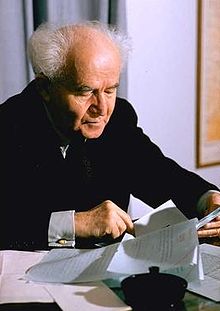
David Ben-Gurion, Israel's first prime minister

Secret Nukes and JFK

Even as it backed down in the Sinai, Israel was involved in another monumental deception, a plan for building its own nuclear arsenal.

In 1956, Israel had concluded an agreement with France to build a nuclear reactor in the Negev desert. Israel also signed a secret agreement with France to build an adjacent plutonium reprocessing plant.

Israel began constructing its nuclear plant in 1958. However, French President Charles de Gaulle was worried about nuclear weapons destabilizing the Middle East and insisted that Israel not develop a nuclear bomb from the plutonium processing plant. Prime Minister Ben-Gurion assured de Gaulle that the processing plant was for peaceful purposes only.

After John F. Kennedy became President, he also wrote to Ben-Gurion explicitly calling on Israel not to join the nuclear-weapons club, drawing another pledge from Ben-Gurion that Israel had no such intention.

Nevertheless, Kennedy continued to press, forcing the Israelis to let U.S. scientists inspect the nuclear reactor at Dimona. But the Israelis first built a fake control room while bricking up and otherwise disguising parts of the building that housed the plutonium processing plant.

In return for allowing inspectors into Dimona, Ben-Gurion also demanded that the United States sell Hawk surface-to-air missiles to the Israeli military. Kennedy agreed to the sale as a show of good faith. Subsequently, however, the CIA got wind of the Dimona deception and leaked to the press that Israel was secretly building a nuclear bomb.

After Kennedy’s assassination, President Lyndon Johnson also grew concerned over Israel’s acquiring nuclear weapons. He asked then-Prime Minister Levi Eshkol to sign the Nuclear Non-Proliferation Treaty.

Eshkol assured Johnson that Israel was studying the matter and would sign the treaty in due course. However, Israel has never signed the treaty and never has admitted that it developed nuclear weapons. [For details, See Israel and The Bomb by Avner Cohen.]

Trapping Johnson

As Israel grew more sophisticated – and more confident – in its dealings with U.S. presidents, it also sought to secure U.S. military assistance by exaggerating its vulnerability to Arab attacks.

One such case occurred after the Egyptians closed off the Gulf of Aqaba to Israel in May 1967, denying the country its only access to the Red Sea. Israel threatened military action against Egypt if it did not re-open the Gulf.

Israel then asked President Johnson for military assistance in the event war broke out against the Egyptians. Johnson directed Richard Helms, the newly appointed head of the CIA to evaluate Israel’s military capability in the event of war against the surrounding Arab states.

On May 26, 1967, Israeli Foreign Minister Abba Eban met with Johnson, Secretary of Defense Robert McNamara, and CIA Director Helms. Eban presented a Mossad estimate of the capability of the Arab armies, claiming that Israel was seriously outgunned by the Arab armies which had been supplied with advanced Soviet weaponry.

Israel believed that, owing to its special relationship with the United States, the Mossad intelligence assessment would be taken at face value.

However, Helms was asked to present the CIA estimate of the Arabs’ military capabilities versus the Israeli army. The CIA’s analysts concluded that Israel could “defend successfully against simultaneous Arab attacks on all fronts, or hold on any three fronts while mounting a successful major offensive on the fourth.” [See “C.I.A. Analysis of the 1967 Arab Israeli War,” Center for the Study of Intelligence.]

“We do not believe that the Israeli appreciation was a serious estimate of the sort they would submit to their own high officials,” the CIA report said. “It is probably a gambit intended to influence the U.S. to provide military supplies, make more public commitments to Israel, to approve Israeli military initiatives, and put more pressure on Egyptian President Nasser.” [See A Look Over My Shoulder by Richard Helms.]

The CIA report stated further that the Soviet Union would probably not interfere militarily on behalf of the Arab states and that Israel would defeat the combined Arab armies in a matter of days.

As a consequence, Johnson refused to airlift special military supplies to Israel, or to promise public support for Israel if Israel went to war.

The Six-Day Success

Despite Johnson’s resistance, Israel launched an attack on its Arab neighbors on June 5, 1967, claiming that the conflict was provoked when Egyptian forces opened fire. (The CIA later concluded that it was Israel that had first fired upon Egyptian forces.)

On June 8, at the height of the conflict, which would become known as the Six-Day War, Israeli fighter/bombers attacked the USS Liberty, a lightly armed communications vessel sent on a mission to relay information on the course of the war to U.S. naval intelligence.

The attack killed 34 Americans sailors, and wounded 171 others. Israeli leaders have always claimed that they had mistaken the U.S. vessel for an enemy ship, but a number of U.S. officials, including Secretary of State Dean Rusk, believed the attack was deliberate, possibly to prevent the United States from learning about Israel’s war plans. [See As I Saw It by Dean Rusk.]

However, in deference to Israel, the U.S. government did not aggressively pursue the matter of the Liberty attack and even issued misleading accounts in medal citations to crew members, leaving out the identity of the attackers.

Meanwhile, on land and in the air, Israel’s powerful military advanced, shredding the Arab defenses. Soon, the conflict escalated into another potential showdown between nuclear-armed superpowers, the Soviet Union and the United States.

On June 10, President Johnson received a “Hot Line” message from Soviet Premier Alexi Kosygin. The Kremlin warned of grave consequences if Israel continued its military campaign against Syria by entering and/or occupying that country.

Johnson dispatched the Sixth Fleet to the Mediterranean, in a move to convince the Soviets of American resolve. But a ceasefire was declared later the same day, with Israel ending up in control of Syria’s Golan Heights, Egypt’s Sinai, and Palestinian lands including Gaza and East Jerusalem.

But a wider war was averted. Johnson’s suspicions about Israel’s expansionist intent had kept the United States from making an even bigger commitment that might have led to the Soviets countering with an escalation of their own.

Nixon and Yom Kippur

Israeli occupation of those additional Arab lands set the stage for a resumption of hostilities six years later, on Oct. 6, 1973, with the Yom Kippur War, which began with a surprise attack by Egypt against Israeli forces in the Sinai.

The offensive caught Israel off guard and Arab forces were close to overrunning Israel’s outer defenses and entering the country. According to later accounts based primarily on Israeli leaks, Prime Minister Golda Meir and her “kitchen cabinet” ordered the arming of 13 nuclear weapons, which were aimed at Egyptian and Syrian targets.

Israeli Ambassador to the United States Simha Dintz warned President Richard Nixon that very serious repercussions would occur if the United States did not immediately begin an airlift of military equipment and personnel to Israel.

Fearing that the Soviet Union might intervene and that nuclear war was possible, the U.S. military raised its alert level to DEFCON-3. U.S. Airborne units in Italy were put on full alert, and military aid was rushed to Israel.

Faced with a well-supplied Israeli counteroffensive and possible nuclear annihilation, the Arab forces fell back. The war ended on Oct. 26, 1973, but the United States had again been pushed to the brink of a possible superpower confrontation due to the unresolved Israeli-Arab conflict.

Nuclear ‘Ambiguity’

On Sept. 22, 1979, after some clouds unexpectedly broke over the South Indian Ocean, a U.S. intelligence satellite detected two bright flashes of light that were quickly interpreted as evidence of a nuclear test.

The explosion was apparently one of several nuclear tests that Israel had undertaken in collaboration with the white-supremacist government of South Africa. But President Jimmy Carter – at the start of his reelection bid – didn’t want a showdown with Israel, especially on a point as sensitive as its secret nuclear work with the pariah government in Pretoria.

So, after news of the nuclear test leaked a month later, the Carter administration followed Israel’s longstanding policy of “ambiguity” about the existence of its nuclear arsenal, a charade dating back to Richard Nixon’s presidency with the United States pretending not to know for sure that Israel possessed nuclear bombs.

The Carter administration quickly claimed that there was “no confirmation” of a nuclear test, and a panel was set up to conclude that the flashes were “probably not from a nuclear explosion.”

However, as investigative reporter Seymour Hersh and various nuclear experts later concluded, the flashes were most certainly an explosion of a low-yield nuclear weapon. [For details, see Hersh’s Samson Option.]

Getting Carter

Despite Carter’s helpful cover-up of the Israeli-South African nuclear test, he was still viewed with disdain by Israel’s hard-line Likud leadership. Indeed, he arguably was the target of Israel’s most audacious intervention in U.S. politics.

Prime Minister Menachem Begin was furious at Carter over the 1978 Camp David accords in which the U.S. President pushed the Israelis into returning the Sinai to the Egyptians in exchange for a peace agreement.

The next year, Carter failed to protect the Shah of Iran, an important Israeli regional ally who was forced from power by Islamic militants. Then, when Carter acceded to demands from the Shah’s supporters to admit him to New York for cancer treatment, Iranian radicals seized the U.S. Embassy in Tehran and held 52 Americans hostage.

In 1980, as Carter focused on his reelection campaign, Begin saw both dangers and opportunities. High-ranking Israeli diplomat/spy David Kimche described Begin’s thinking in the 1991 book, The Last Option, recounting how Begin feared that Carter might force Israel to withdraw from the West Bank and accept a Palestinian state if he won a second term.

“Begin was being set up for diplomatic slaughter by the master butchers in Washington,” Kimche wrote. “They had, moreover, the apparent blessing of the two presidents, Carter and [Egyptian President Anwar] Sadat, for this bizarre and clumsy attempt at collusion designed to force Israel to abandon her refusal to withdraw from territories occupied in 1967, including Jerusalem, and to agree to the establishment of a Palestinian state.”

Begin’s alarm was driven by the prospect of Carter being freed from the pressure of having to face another election, according to Kimche.

“Unbeknownst to the Israeli negotiators, the Egyptians held an ace up their sleeves, and they were waiting to play it,” Kimche wrote. “The card was President Carter’s tacit agreement that after the American presidential elections in November 1980, when Carter expected to be re-elected for a second term, he would be free to compel Israel to accept a settlement of the Palestinian problem on his and Egyptian terms, without having to fear the backlash of the American Jewish lobby.”

So, by spring 1980, Begin had privately sided with Carter’s Republican rival, Ronald Reagan, a reality that Carter soon realized.

Questioned by congressional investigators in 1992 regarding allegations about Israel conspiring with Republicans in 1980 to help unseat him, Carter said he knew by April 1980 that “Israel cast their lot with Reagan,” according to notes found among the unpublished documents in the files of a House task force that looked into the so-called October Surprise case.

Carter traced the Israeli opposition to his reelection to a “lingering concern [among] Jewish leaders that I was too friendly with Arabs.”

Doing What Was Necessary

Begin was an Israeli leader committed to do whatever he felt necessary to advance Israeli security interests and the dream of a Greater Israel with Jews controlling the ancient Biblical lands. Before Israel’s independence in 1948, he had led a Zionist terrorist group, and he founded the right-wing Likud Party in 1973 with the goal of “changing the facts on the ground” by placing Jewish settlements in Palestinian areas.

Begin’s anger over the Sinai deal and his fear of Carter’s reelection set the stage for secret collaboration between Begin and the Republicans, according to another former Israeli intelligence official, Ari Ben-Menashe.

“Begin loathed Carter for the peace agreement forced upon him at Camp David,” Ben-Menashe wrote in his 1992 memoir, Profits of War. “As Begin saw it, the agreement took away Sinai from Israel, did not create a comprehensive peace, and left the Palestinian issue hanging on Israel’s back.”

Ben-Menashe, an Iranian-born Jew who had immigrated to Israel as a teen-ager, became part of a secret Israeli program to reestablish its Iranian intelligence network that had been decimated by the Islamic revolution. Ben-Menashe wrote that Begin authorized shipments to Iran of small arms and some military spare parts, via South Africa, as early as September 1979 and continued them despite Iran’s seizure of the U.S. hostages in November 1979.

Extensive evidence also exists that Begin’s preference for Reagan led the Israelis to join in a covert operation with Republicans to contact Iranian leaders behind Carter’s back, interfering with the President’s efforts to free the 52 American hostages before the November 1980 elections.

That evidence includes statements from senior Iranian officials, international arms dealers, intelligence operatives, and Middle East political figures (including a cryptic confirmation from Begin’s successor Yitzhak Shamir). But the truth about the October Surprise case remains in dispute to this day. [For details, see Robert Parry’s Secrecy & Privilege.]

It is clear that after Reagan defeated Carter — and the U.S. hostages were released immediately upon Reagan being sworn in on Jan. 20, 1981 — Israeli-brokered weapons shipments flowed to Iran with the secret blessing of the new Republican administration.

Dealing with Reagan

The Israel Lobby had grown exponentially since its start in the Eisenhower years. Israel’s influential supporters were now positioned to use every political device imaginable to lobby Congress and to get the White House to acquiesce to whatever Israel felt it needed.

President Reagan also credentialed into the Executive Branch a new group of pro-Israeli American officials – the likes of Elliott Abrams, Richard Perle, Michael Ledeen and Jeane Kirkpatrick – who became known as the neocons.

Yet, despite Reagan’s pro-Israel policies, the new U.S. President wasn’t immune from more Israeli deceptions and additional pressures.

Indeed, whether because of the alleged collusion with Reagan during the 1980 campaign or because Israel sensed its greater clout within his administration, Begin demonstrated a new level of audacity.

In 1981, Israel recruited Jonathan Pollard, an American Navy intelligence analyst, as a spy to acquire American intelligence satellite photos. Eventually, Pollard purloined massive amounts of intelligence information, some of which was reportedly turned over to Soviet intelligence by Israel to win favors from Moscow.

Prime Minister Begin sensed, too, that the time was ripe to gain the upper hand on other Arab enemies. He turned his attention to Lebanon, where the Palestine Liberation Organization was based.

Lebanon War

When U.S. intelligence warned Reagan that Israel was massing troops along the border with Lebanon, Reagan sent a cable to Begin urging him not to invade. But Begin ignored Reagan’s plea and invaded Lebanon the following day, on June 6, 1982. [See Time, Aug. 16, 1982.]

As the offensive progressed, Reagan sought a cessation of hostilities between Israel and the PLO, but Israel was intent on killing as many PLO fighters as possible. Periodic U.S.-brokered ceasefires failed as Israel used the slightest provocation to resume fighting, supposedly in self-defense.

“When PLO sniper fire is followed by fourteen hours of Israeli bombardment that is stretching the definition of defensive action too far,” complained Reagan, who kept the picture of a horribly burned Lebanese child on his desk in the Oval Office as a reminder of the tragedy of Lebanon.

The American public nightly witnessed the Israeli bombardment of Beirut on television news broadcasts. The pictures of dead, mutilated children caught in the Israeli artillery barrages, were particularly wrenching. Repulsed by the carnage, the U.S. public decidedly favored forcing Israel to stop.

When Reagan warned Israel of possible sanctions if its forces continued to indiscriminately attack Beirut, Israel launched a major offensive against West Beirut the next day.

In the United States, Israeli supporters demanded a meeting with Reagan to press Israel’s case. Though Reagan declined the meeting, one was set up for 40 leaders of various Jewish organizations with Vice President George H.W. Bush, Defense Secretary Caspar Weinberger and Secretary of State George Shultz.

Reagan wrote once again to Begin, reminding him that Israel was allowed to use American weapons only for defensive purposes. He appealed to Begin’s humanitarianism to stop the bombardment.

The next day, in a meeting with Israeli supporters from the United States, Begin fumed that he would not be instructed by an American president or any other U.S. official.

“Nobody is going to bring Israel to her knees. You must have forgotten that Jews do not kneel but to God,” Begin said. “Nobody is going to preach to us humanitarianism.”

Begin’s government also used the tragedy in Lebanon as an opportunity to provide special favors for its American backers.

In From Beirut to Jerusalem, New York Times correspondent Thomas L. Freidman wrote that the Israeli Army conducted tours of the battlefront for influential U.S. donors. On one occasion, women from Hadassah were taken to the hills surrounding Beirut and were invited to look down on the city as Israeli artillery put on a display for them.

The artillery began an enormous barrage, with shells landing throughout the densely populated city. The shells struck and destroyed apartments, shops, homes and shacks

Thursday, December 30, 2010

The Great Islamophobic Crusade

Max Blumenthal: Meet the Bizarre Cabal Behind an Increasingly Paranoid Crusade


(CBS)  Max Blumenthal is a writing fellow for the Nation Institute and author of the bestselling book Republican Gomorrah: Inside the Movement That Shattered the Party (Nation Books).  This piece originally appeared on TomDispatch.


Nine years after 9/11, hysteria about Muslims in American life has gripped the country.

With it has gone an outburst of arson attacks on mosques, campaigns to stop their construction, and the branding of the Muslim-American community, overwhelmingly moderate, as a hotbed of potential terrorist recruits. The frenzy has raged from rural Tennessee to New York City, while in Oklahoma, voters even overwhelmingly approved a ballot measure banning the implementation of Sharia law in American courts (not that such a prospect existed). This campaign of Islamophobia wounded President Obama politically, as one out of five Americans have bought into a sustained chorus of false rumors about his secret Muslim faith. And it may have tainted views of Muslims in general; an August 2010 Pew Research Center poll revealed that, among Americans, the favorability rating of Muslims had dropped by 11 points since 2005.

Erupting so many years after the September 11th trauma, this spasm of anti-Muslim bigotry might seem oddly timed and unexpectedly spontaneous. But think again: it’s the fruit of an organized, long-term campaign by a tight confederation of right-wing activists and operatives who first focused on Islamophobia soon after the September 11th attacks, but only attained critical mass during the Obama era.  It was then that embittered conservative forces, voted out of power in 2008, sought with remarkable success to leverage cultural resentment into political and partisan gain.

This network is obsessively fixated on the supposed spread of Muslim influence in America. Its apparatus spans continents, extending from Tea Party activists here to the European far right. It brings together in common cause right-wing ultra-Zionists, Christian evangelicals, and racist British soccer hooligans. It reflects an aggressively pro-Israel sensibility, with its key figures venerating the Jewish state as a Middle Eastern Fort Apache on the front lines of the Global War on Terror and urging the U.S. and various European powers to emulate its heavy-handed methods.

Little of recent American Islamophobia (with a strong emphasis on the “phobia”) is sheer happenstance.  Years before Tea Party shock troops massed for angry protests outside the proposed site of an Islamic community center in lower Manhattan, representatives of the Israel lobby and the Jewish-American establishment launched a campaign against pro-Palestinian campus activism that would prove a seedbed for everything to come. That campaign quickly -- and perhaps predictably -- morphed into a series of crusades against mosques and Islamic schools which, in turn, attracted an assortment of shady but exceptionally energetic militants into the network’s ranks.

Besides providing the initial energy for the Islamophobic crusade, conservative elements from within the pro-Israel lobby bankrolled the network’s apparatus, enabling it to influence the national debate. One philanthropist in particular has provided the beneficence to propel the campaign ahead. He is a little-known Los Angeles-area software security entrepreneur named Aubrey Chernick, who operates out of a security consulting firm blandly named the National Center for Crisis and Continuity Coordination. A former trustee of the Washington Institute for Near East Policy, which has served as a think tank for the American Israel Policy Action Committee (AIPAC), a frontline lobbying group for Israel, Chernick is said to be worth $750 million.

Chernick’s fortune is puny compared to that of the billionaire Koch Brothers, extraction industry titans who fund Tea Party-related groups like Americans for Prosperity, and it is dwarfed by the financial empire of Haim Saban, the Israeli-American media baron who is one of the largest private donors to the Democratic party and recently matched $9 million raised for the Friends of the Israeli Defense Forces in a single night. However, by injecting his money into a small but influential constellation of groups and individuals with a narrow agenda, Chernick has had a considerable impact.

Through the Fairbrook Foundation, a private entity he and his wife Joyce control, Chernick has provided funding to groups ranging from the Anti-Defamation League (ADL) and CAMERA, a right-wing, pro-Israel, media-watchdog outfit, to violent Israeli settlers living on Palestinian lands and figures like the pseudo-academic author Robert Spencer, who is largely responsible for popularizing conspiracy theories about the coming conquest of the West by Muslim fanatics seeking to establish a worldwide caliphate. Together, these groups spread hysteria about Muslims into Middle American communities where immigrants from the Middle East have recently settled, and they watched with glee as likely Republican presidential frontrunners from Mike Huckabee to Sarah Palin promoted their cause and parroted their tropes. Perhaps the only thing more surprising than the increasingly widespread appeal of Islamophobia is that, just a few years ago, the phenomenon was confined to a few college campuses and an inner city neighborhood, and that it seemed like a fleeting fad that would soon pass from the American political landscape.

Birth of a Network

The Islamophobic crusade was launched in earnest at the peak of George W. Bush’s prestige when the neoconservatives and their allies were riding high. In 2003, three years after the collapse of President Bill Clinton’s attempt to resolve the Israeli-Palestinian issue and in the immediate wake of the invasion of Iraq, a network of Jewish groups, ranging from ADL and the American Jewish Committee to AIPAC, gathered to address what they saw as a sudden rise in pro-Palestinian activism on college campuses nationwide. That meeting gave birth to the David Project, a campus advocacy group led by Charles Peters, who had co-founded CAMERA, one of the many outfits bankrolled by Chernick. With the help of public relations professionals, Peters conceived a plan to “take back the campus by influencing public opinion through lectures, the Internet, and coalitions,” as a memo produced at the time by the consulting firm McKinsey and Company stated.

In 2004, after conferring with Martin Kramer, a fellow at the Washington Institute for Near East Policy, the pro-Israel think tank where Chernoff had served as a trustee, Peters produced a documentary film that he called Columbia Unbecoming.  It was filled with claims from Jewish students at Columbia University claiming they had endured intimidation and insults from Arab professors.  The film portrayed that New York City school’s Department of Middle East and Asian Languages and Cultures as a hothouse of anti-Semitism.

In their complaints, the students focused on one figure in particular: Joseph Massad, a Palestinian professor of Middle East studies.  He was known for his passionate advocacy of the formation of a binational state between Israel and Palestine, as well as for his strident criticism of what he termed “the racist character of Israel.” The film identified him as “one of the most dangerous intellectuals on campus,” while he was featured as a crucial villain in The Professors: The 101 Most Dangerous Academics in America, a book by the (Chernick-funded) neoconservative activist David Horowitz.  As Massad was seeking tenure at the time, he was especially vulnerable to this sort of wholesale assault.

When the controversy over Massad’s views intensified, Congressman Anthony Weiner, a liberal New York Democrat who once described himself as a representative of “the ZOA [Zionist Organization of America] wing of the Democratic Party,” demanded that Columbia President Lee Bollinger, a renowned First Amendment scholar, fire the professor. Bollinger responded by issuing uncharacteristically defensive statements about the “limited” nature of academic freedom.

In the end, however, none of the charges stuck. Indeed, the testimonies in the David Project film were eventually either discredited or never corroborated. In 2009, Massad earned tenure after winning Columbia’s prestigious Lionel Trilling Award for excellence in scholarship.

Having demonstrated its ability to intimidate faculty members and even powerful university administrators, however, Kramer claimed a moral victory in the name of his project, boasting to the press that “this is a turning point.” While the David Project subsequently fostered chapters on campuses nationwide, its director set out on a different path -- initially, into the streets of Boston in 2004 to oppose the construction of the Islamic Society of Boston Cultural Center.

For nearly 15 years, the Islamic Society of Boston had sought to build the center in the heart of Roxbury, the city’s largest black neighborhood, to serve its sizable Muslim population. With endorsements from Mayor Thomas Menino and leading Massachusetts lawmakers, the mosque’s construction seemed like a fait accompli -- until, that is, the Rupert Murdoch-owned Boston Herald and his local Fox News affiliate snapped into action.  Boston Globe columnist Jeff Jacoby also chimed in with a series of reports claiming the center’s plans were evidence of a Saudi Arabian plot to bolster the influence of radical Islam in the United States, and possibly even to train underground terror cells.

It was at this point that the David Project entered the fray, convening elements of the local pro-Israel community in the Boston area to seek strategies to torpedo the project. According to emails obtained by the Islamic Society’s lawyers in a lawsuit against the David Project, the organizers settled on a campaign of years of nuisance lawsuits, along with accusations that the center had received foreign funding from “the Wahhabi movement in Saudi Arabia or… the Moslem Brotherhood.”

In response, a grassroots coalition of liberal Jews initiated inter-faith efforts aimed at ending a controversy that had essentially been manufactured out of thin air and was corroding relations between the Jewish and Muslim communities in the city. Peters would not, however, relent. “We are more concerned now than we have ever been about a Saudi influence of local mosques,” he announced at a suburban Boston synagogue in 2007.

After paying out millions of dollars in legal bills and enduring countless smears, the Islamic Society of Boston completed the construction of its community center in 2008. Meanwhile, not surprisingly, nothing came of the David Project’s dark warnings. As Boston-area National Public Radio reporter Philip Martin reflected in September 2010, “The horror stories that preceded [the center’s] development seem shrill and histrionic in retrospect.”


The Network Expands

This second failed campaign was, in the end, more about movement building than success, no less national security. The local crusade established an effective blueprint for generating hysteria against the establishment of Islamic centers and mosques across the country, while galvanizing a cast of characters who would form an anti-Muslim network which would gain attention and success in the years to come.

In 2007, these figures coalesced into a proto-movement that launched a new crusade, this time targeting the Khalil Gibran International Academy, a secular Arabic-English elementary school in Brooklyn, New York. Calling their ad hoc pressure group, Stop the Madrassah -- madrassah being simply the Arab word for “school” -- the coalition’s activists included an array of previously unknown zealots who made no attempt to disguise their extreme views when it came to Islam as a religion, as well as Muslims in America. Their stated goal was to challenge the school’s establishment on the basis of its violation of the church-state separation in the U.S. Constitution.  The true aim of the coalition, however, was transparent: to pressure the city’s leadership to adopt an antagonistic posture towards the local Muslim community.

The activists zeroed in on the school’s principal, Debbie Almontaser, a veteran educator of Yemeni descent, and baselessly branded her “a jihadist” as well as a 9/11 denier.  They also accused her of -- as Pamela Geller, a far-right blogger just then gaining prominence put it, “whitewash[ing] the genocide against the Jews.”  Daniel Pipes, a neoconservative academic previously active in the campaigns against Joseph Massad and the Boston Islamic center (and whose pro-Likud think tank, Middle East Forum, has received $150,000 from Chernick) claimed the school should not go ahead because “Arabic-language instruction is inevitably laden with Pan-Arabist and Islamist baggage.” As the campaign reached a fever pitch, Almontaser reported that members of the coalition were actually stalking her wherever she went.

Given what Columbia Journalism School professor and former New York Times reporter Samuel Freedman called “her clear, public record of interfaith activism and outreach,” including work with the New York Police Department and the Anti-Defamation League after the September 11th attacks, the assault on Almontaser seemed little short of bizarre -- until her assailants discovered a photograph of her wearing a T-shirt produced by AWAAM, a local Arab feminist organization, that read “Intifada NYC.” (“As AWAAM provides young women with opportunities to become active as community organizers and media producers, ‘intifada NYC’ is a call for empowerment, service, civic participation and critical thinking in our communities,” the organization explained once the controversy erupted.)

Having found a way to wedge the emotional issue of the Israel-Palestine conflict into a previously New York-centered campaign, the school’s opponents next gained a platform at the Murdoch-owned New York Post, where reporters Chuck Bennett and Jana Winter claimed her T-shirt was “apparently a call for a Gaza-style uprising in the Big Apple.” While Almontaser attempted to explain to the Post’s reporters that she rejected terrorism, the Anti-Defamation League chimed in on cue. ADL spokesman Oren Segal told the Post: “The T-shirt is a reflection of a movement that increasingly lauds violence against Israelis instead of rejecting it. That is disturbing.”

Before any Qassam rockets could be launched from Almonstaser’s school, her former ally New York Mayor Michael Bloomberg caved to the growing pressure and demanded her resignation, prompting the state’s Department of Education to fire her. A Jewish principal who spoke no Arabic replaced Almontaser, who later filed a lawsuit against the city for breaching her free speech rights. In 2010, the Equal Employment Opportunity Commission ruled that New York’s Department of Education had “succumbed to the very bias that the creation of the school was intended to dispel” by firing Almontaser and urged it pay her $300,000 in damages. The commission also concluded that the Post had quoted her misleadingly.

Though it failed to stop the establishment of the Khalil Gibran Academy, the burgeoning anti-Muslim movement succeeded in forcing city leaders to bend to its will, and having learned just how to do that, then moved on in search of more high-profile targets. As the New York Times reported at the time, "The fight against the school... was only an early skirmish in a broader, national struggle."

“It’s a battle that has really just begun,” Pipes told the Times.

From Scam to Publicity Coup

Pipes couldn’t have been more on the mark. In late 2009, the Islamophobes sprang into action again when the Cordoba Initiative, a non-profit Muslim group headed by Feisal Abdul Rauf, an exceedingly moderate Sufi Muslim imam who regularly traveled abroad representing the United States at the behest of the State Department, announced that it was going to build a community center in downtown New York City. With the help of investors, Rauf’s Cordoba Initiative purchased space two blocks from Ground Zero in Manhattan.  The space was to contain a prayer area as part of a large community center that would be open to everyone in the neighborhood.

None of these facts mattered to Pamela Geller. Thanks to constant prodding at her blog, Atlas Shrugged, Geller made Cordoba’s construction plans a national issue, provoking fervent calls from conservatives to protect the “hallowed ground” of 9/11 from creeping Sharia. (That the “mosque” would have been out of sight of Ground Zero and that the neighborhood was, in fact, filled with everything from strip clubs to fast-food joints didn't matter.)  Geller’s activism against Cordoba House earned the 52-year-old full-time blogger the attention she apparently craved, including a long profile in the New York Times and frequent cable news spots, especially, of course, on Fox News.

Mainstream reporters tended to focus on Geller’s bizarre stunts.  She posted a video of herself splashing around in a string bikini on a Fort Lauderdale beach, for instance, while ranting about “left-tards” and “Nazi Hezbollah.”  Her call for boycotting Campbell’s Soup because the company offered halal -- approved under Islamic law (as kosher food is under Jewish law) -- versions of its products got her much attention, as did her promotion of a screed claiming that President Barack Obama was the illegitimate lovechild of Malcolm X.

Geller had never earned a living as a journalist.  She supported herself with millions of dollars in a divorce settlement and life insurance money from her ex-husband.  He died in 2008, a year after being indicted for an alleged $1.3 million scam he was accused of running out of a car dealership he co-owned with Geller. Independently wealthy and with time on her hands, Geller proved able indeed when it came to exploiting her strange media stardom to incite the already organized political network of Islamophobes to intensify their crusade.

She also benefited from close alliances with leading Islamophobes from Europe. Among Geller’s allies was Andrew Gravers, a Danish activist who formed the group Stop the Islamicization of Europe, and gave it the unusually blunt motto: “Racism is the lowest form of human stupidity, but Islamophobia is the height of common sense.” Gravers’ group inspired Geller’s own U.S.-based outfit, Stop the Islamicization of America, which she formed with her friend Robert Spencer, a pseudo-scholar from Great Britain whose bestselling books, including The Truth About Muhammad, Founder of the World’s Most Intolerant Religion, prompted former advisor to President Richard Nixon and Muslim activist Robert Crane to call him, “the principal leader… in the new academic field of Muslim bashing.” (According to the website Politico, almost $1 million in donations from Chernick has been steered to Spencer’s Jihad Watch group through David Horowitz’s Freedom Center.)

Perfect sources for Republican political figures in search of the next hot-button cause, their rhetoric found its way into the talking points of Newt Gingrich and Sarah Palin as they propelled the crusade against Cordoba House into the national spotlight. Gingrich soon compared the community center to a Nazi sign next to the Holocaust Memorial Museum, while Palin called it “a stab in the heart” of “the Heartland.” Meanwhile, Tea Party candidates like Republican Ilario Pantano, an Iraq war veteran who killed two unarmed Iraqi civilians, shooting them 60 times -- he even stopped to reload -- made their opposition to Cordoba House the centerpiece of midterm congressional campaigns conducted hundreds of miles from Ground Zero.
Geller’s campaign against “the mosque at Ground Zero” gained an unexpected assist and a veneer of legitimacy from established Jewish leaders like Anti-Defamation League National Director Abraham Foxman. “Survivors of the Holocaust are entitled to feelings that are irrational,” he remarked to the New York Times. Comparing the bereaved family members of 9-11 victims to Holocaust survivors, Foxman insisted, “Their anguish entitles them to positions that others would categorize as irrational or bigoted.”

Soon enough, David Harris, director of the (Chernick-funded) American Jewish Committee, was demanding that Cordoba’s leaders be compelled to reveal their “true attitudes” about Palestinian militant groups before construction on the center was initiated.  Rabbi Marvin Hier of the Simon Wiesenthal Center of Los Angeles, another major Jewish group, insisted it would be “insensitive” for Cordoba to build near “a cemetery,” though his organization had recently been granted permission from the municipality of Jerusalem to build a “museum of tolerance” to be called The Center for Human Dignity directly on top of the Mamilla Cemetery, a Muslim graveyard that contained thousands of gravesites dating back 1,200 years.

Inspiration from Israel

It was evident from the involvement of figures like Gravers and Spencer that the Islamophobic network in the United States represented a trans-Atlantic expansion of simmering resentment in Europe.  There, the far-right was storming to victories in parliamentary elections across the continent in part by appealing to the simmering anti-Muslim sentiments of voters in rural and working-class communities. The extent of the collaboration between European and American Islamophobes has only continued to grow with Geller, Spencer, and even Gingrich standing beside Europe’s most prominent anti-Muslim figure, Dutch parliamentarian Geert Wilders, at a rally against Cordoba House.  In the meantime, Geller was issuing statements of support for the English Defense League, a band of unreconstructed neo-Nazis and former members of the whites-only British National Party who intimidate Muslims in the streets of cities like Birmingham and London.

In addition, the trans-Atlantic Islamophobic crusade has stretched into Israel, a country that has come to symbolize the network’s fight against the Muslim menace. As Geller told the New York Times’ Alan Feuer, Israel is “a very good guide because, like I said, in the war between the civilized man and the savage, you side with the civilized man.”

EDL members regularly wave Israeli flags at their rallies, while Wilders claims to have formed his views about Muslims during the time he worked on an Israeli cooperative farm in the 1980s. He has, he says, visited the country more than 40 times since to meet with rightist political allies like Aryeh Eldad, a member of the Israeli Knesset and leader of the far right Hatikvah faction of the National Union Party.  He has called for forcibly “transferring” the Palestinians living in Israel and the occupied West Bank to Jordan and Egypt. On December 5th, for example, Wilders traveled to Israel for a “friendly” meeting with Foreign Minister Avigdor Lieberman, then declared at a press conference that Israel should annex the West Bank and set up a Palestinian state in Jordan.

In the apocalyptic clash of civilizations the global anti-Muslim network has sought to incite, tiny armed Jewish settlements like Yitzar, located on the hills above the occupied Palestinian city of Nablus, represent front-line fortresses. Inside Yitzar’s state-funded yeshiva, a rabbi named Yitzhak Shapira has instructed students in what rules must be applied when considering killing non-Jews. Shapira summarized his opinions in a widely publicized book, Torat HaMelech, or The King’s Torah. Claiming that non-Jews are “uncompassionate by nature,” Shapira cited rabbinical texts to declare that gentiles could be killed in order to “curb their evil inclinations.” “There is justification,” the rabbi proclaimed, “for killing babies if it is clear that they will grow up to harm us, and in such a situation they may be harmed deliberately, and not only during combat with adults.”

In 2006, the rabbi was briefly held by Israeli police for urging his supporters to murder all Palestinians over the age of 13. Two years later, according to the Israeli newspaper Haaretz, he signed a rabbinical letter in support of Israeli Jews who had brutally assaulted two Arab youths on the country's Holocaust Remembrance Day. That same year, Shapira was arrested as a suspect in helping orchestrate a rocket attack against a Palestinian village near Nablus.

Though he was not charged, his name came up again in connection with another act of terror when, in January 2010, the Israeli police raided his settlement seeking vandals who had set fire to a nearby mosque. One of Shapira's followers, an American immigrant, Jack Teitel, has confessed to murdering two innocent Palestinians and attempting to the kill the liberal Israeli historian Ze'ev Sternhell with a mail bomb. 

What does all this have to do with Islamophobic campaigns in the United States?  A great deal, actually. Through New York-based tax-exempt non-profits like the Central Fund of Israel and Ateret Cohenim, for instance, the omnipresent Aubrey Chernick has sent tens of thousands of dollars to support the Yitzar settlement, as well as to the messianic settlers dedicated to “Judaizing” East Jerusalem. The settlement movement’s leading online news magazine, Arutz Sheva, has featured Geller as a columnist.  A friend of Geller’s, Beth Gilinsky, a right-wing activist with a group called the Coalition to Honor Ground Zero and the founder of the Jewish Action Alliance (apparently run out of a Manhattan real estate office), organized a large rally in New York City in April 2010 to protest the Obama administration’s call for a settlement freeze.

Among Chernick’s major funding recipients is a supposedly “apolitical” group called Aish Hatorah that claims to educate Jews about their heritage. Based in New York and active in the fever swamps of northern West Bank settlements near Yitzar, Aish Hatorah shares an address and staff with a shadowy foreign non-profit called the Clarion Fund. During the 2008 U.S. election campaign, the Clarion Fund distributed 28 million DVDs of a propaganda film called Obsession as newspaper inserts to residents of swing states around the country. The film featured a who’s who of anti-Muslim activists, including Walid Shoebat, a self-proclaimed “former PLO terrorist.” Among Shoebat’s more striking statements: “A secular dogma like Nazism is less dangerous than is Islamofascism today.” At a Christian gathering in 2007, this “former Islamic terrorist” told the crowd that Islam was a “satanic cult” and that he had been born again as an evangelical Christian. In 2008, however, the Jerusalem Post, a right-leaning newspaper, exposed him as a fraud, whose claims to terrorism were fictional.

Islamophobic groups registered only a minimal impact during the 2008 election campaign. Two years later, however, after the Republicans regained control of the House of Representatives in midterm elections, the network appears to have reached critical mass. Of course, the deciding factor in the election was the economy, and in two years, Americans will likely vote their pocketbooks again. But that the construction of a single Islamic community center or the imaginary threat of Sharia law were issues at all reflected the influence of a small band of locally oriented activists, and suggested that when a certain presidential candidate who has already been demonized as a crypto-Muslim runs for reelection, the country’s most vocal Islamophobes could once again find a national platform amid the frenzied atmosphere of the campaign.

By now, the Islamophobic crusade has gone beyond the right-wing pro-Israel activists, cyber-bigots, and ambitious hucksters who conceived it. It now belongs to leading Republican presidential candidates, top-rated cable news hosts, and crowds of Tea Party activists. As the fervor spreads, the crusaders are basking in the glory of what they accomplished. “I didn’t choose this moment,” Geller mused to the New York Times, “this moment chose me.”

The opinions expressed in this commentary are solely those of the author.