HOME | ABOUT | AUTHOR |HOLOCAUST GENOCIDES | THE GHOUSE DIARY | RELATED SITE
S | FACE BOOK | PHOTO GALLERY | VIDEO GALLERY |

WARNING : This site is not for you if you cannot see the otherness of other and sufferings of both sides of the party in the conflict. Security for Israel and Justice for the Palestinians are interdependent, one will not happen without the other. My view focuses on building cohesive societies where no one has to live in apprehension or fear of the other. I hope and pray a sense of justice to prevail. Amen. Website www.IsraelPalestineDialogue.com | Also Check Israel Palestine Confederation a pragmatic solution

Thursday, February 23, 2012

Peaceful Protest can Free Palestine

By MUSTAFA BARGHOUTHIPublished: February 21, 2012
http://www.nytimes.com/2012/02/22/opinion/peaceful-protest-can-free-palestine.html?_r=2&ref=opinion

OVER the past 64 years, Palestinians have tried armed struggle; we have tried negotiations; and we have tried peace conferences. Yet all we have seen is more Israeli settlements, more loss of lives and resources, and the emergence of a horrifying system of segregation.

Khader Adnan, a Palestinian held in an Israeli prison, pursued a different path. Despite his alleged affiliation with the militant group Islamic Jihad, he waged a peaceful hunger strike to shake loose the consciences of people in Israel and around the world. Mr. Adnan chose to go unfed for more than nine weeks and came close to death. He endured for 66 days before ending his hunger strike on Tuesday in exchange for an Israeli agreement to release him as early as April 17.

Mr. Adnan has certainly achieved an individual victory. But it was also a broader triumph — unifying Palestinians and highlighting the power of nonviolent protest. Indeed, all Palestinians who seek an independent state and an end to the Israeli occupation would be wise to avoid violence and embrace the example of peaceful resistance.

Mr. Adnan was not alone in his plight. More than 300 Palestinians are currently held in “administrative detention.” No charges have been brought against them; they must contend with secret evidence; and they do not get their day in military court.

Britain’s practices in Northern Ireland during the 1970s and 1980s were not so different from Israel’s today — and they elicited a similarly rebellious spirit from the subjugated population. In 1981, Bobby Sands, an imprisoned member of the Irish Republican Army, died 66 days after beginning a hunger strike to protest Britain’s treatment of political prisoners. Mr. Sands was elected to Parliament during his strike; nine other hunger strikers died before the end of 1981; and their cases drew worldwide attention to the plight of Roman Catholics in Northern Ireland.

Just as Margaret Thatcher, then the British prime minister, unsympathetically dismissed Mr. Sands as a “convicted criminal,” Israeli officials have accused Mr. Adnan of being an active member of Islamic Jihad. But if this is the case, Israel should prove it in court.

Mr. Adnan’s actions over the past nine weeks demonstrated that he was willing to give his life — nonviolently and selflessly — to advance Palestinian freedom. Others must now show similar courage.

What is needed is a Palestinian version of the Arab revolutions that have swept the region: a mass movement demanding freedom, dignity, a just peace, real democracy and the right to self-determination. We must take the initiative, practice self-reliance and pursue a form of nonviolent struggle that we can sustain without depending on others to make decisions for us or in our place.

In the last several years, Palestinians have organized peaceful protests against the concrete and wire “separation barrier” that pens us into what are best described as bantustans. We have sought to mobilize popular resistance to this wall by following in the nonviolent traditions of Martin Luther King Jr. and Mohandas K. Gandhi — and we remain determined to sustain peaceful protest even when violently attacked.

Using these techniques, we have already succeeded in pressuring the Israeli government to reroute the wall in villages like Jayyous and Bilin and helped hundreds of Palestinians get their land back from settlers or the Israeli Army.

Our movement is not intended to delegitimize Israel, as the Israeli government claims. It is, instead, a movement to delegitimize the Israeli occupation of the West Bank, which we believe is the last surviving apartheid system in the world. It is a movement that could free Palestinians from nearly 45 years of occupation and Israelis from being part of the last colonial-settler system of our time.

I remember the days when some political leaders of the largest Palestinian political parties, Al Fatah and Hamas, laughed at our nonviolent struggle, which they saw as soft and ineffective. But the turning point came in the summer of 2008, when we managed to break the Israeli naval siege of Gaza with small boats. Suddenly, I saw great respect in the eyes of the same leaders who had doubted the power of nonviolence but finally recognized its potential.

The power of nonviolence is that it gives Palestinians of all ages and walks of life the tools to challenge those subjugating us. And thousands of peace activists from around the world have joined our movement. In demonstrations in East Jerusalem, Silwan and Hebron we are also being joined by a new and younger Israeli peace movement that categorically rejects Israeli occupation.

Unfortunately, continuing Israeli settlement activity could soon lead us to the point of no return. Indeed, if we do not soon achieve a genuinely independent Palestinian state, we will be forced to press instead for a single democratic state with equal rights and responsibilities for both Palestinians and Israelis.

We are not sure how long it will take before our nonviolent struggle achieves its goal. But we are sure of one thing: it will succeed, and Palestinians will one day be free.

Mustafa Barghouthi, a doctor and member of the Palestinian Parliament, is secretary general of the Palestinian National Initiative, a political party.

A version of this op-ed appeared in print on February 22, 2012, on page A23 of the New York edition with the headline: Peaceful Protest Can Free Palestine.

Tuesday, February 21, 2012

Israel Palestine commitment, part 2

Israel's security and justice to the Palestinians are directly proportional to each other. Hundred percent security for Israel comes with 100 percent justice to the Palestinians. A majority of people in the conflict understand this, but the leadership runs aground with short sighted false perceptions.


Huffington post on Israel Palestine solutions : http://www.huffingtonpost.com/mike-ghouse/commitment-to-israelpales_b_1263793.html


- - - - -
Mike Ghouse is committed to building a cohesive America and offers pluralistic solutions on issues of the day. A writer, thinker and a speaker and is available to speak on pluralism, politics, Islam, peace, cohesive societies and a variety of topics. Check out 4 websites and 27 Blogs indexed at www.MikeGhouse.net. Current articles atwww.TheGhousediary.com

Wednesday, February 15, 2012

Dr. Munther Dajani on Israeli Palestinian Confederation

Dr. Munther Dajani is a member of the Israeli Palestinian Confederation, an organization committed to find the path to peace between Israel and Palestine.  We welcome articles and notes that express the human aspirations for peace. IPC is listed on the right panel of this blog.

Mike Ghouse

. . . . . . . . . 

Munther Dajani, dean, Faculty of Arts, AL Quds University, Jerusalem; co-founder,Wasatiyya(Moderation)movement:

This is the statement he was going to deliver at our convention in Jerusalem which was disrupted by demonstrators on December 12, 2011.

My name is Munther  Dajani and I am a humanist, chronic optimist and a citizen of the world.

Dear participants in this historic event, of all walks of life and of all nationalities and professions, the citizens of the State of Palestine and the citizens of the State of Israel.

I am honored to be standing here today among you, we the few who believe in the future of peace to become a reality in this part of the world. Needless to say that we owe our presence here to our American friends who took the initiative to make this meeting possible and specially Mr. Joseph Avesar and his team whose relentless efforts have to be acknowledged in making this gathering possible.

We the citizens of this region are the ones who always end up paying the price of blood-shed and death. Wars that results of meaningless deaths where the rules and regulations are imposed on us by people who already passed away generations ago, we have never met or even know. Decisions that are made maybe thousands of miles away in different capitals of the world, in closed rooms outside our region that we do not have anything to do with on the individual level per say… we who live in this region and in alliance with our friends in the United States and Israel have decided to make a change and as President Obama once said and we can make the Change that we all desperately need. I believe that it is about time that we take our own faith in our own hands and make our own decisions. 

A Decision that we will make today that will affect generations to come to end this protracted conflict that have plagued us for more than eight decades. I am standing here before you to say that we want peace, as most of the polls show that a majority of Palestinians and Israelis are thirsty for peace, peace of mind and body that will secure the well being of our children and their children in the region in particular and the children of the world. Stability that will usher in, economic prosperity, and will make the dream of the late President Arafat and President Shimon Peres come true resulting in a new Middle East based on human dignity and self-respect and respect of others for all regardless of creed, color, religion or ethnicity.

I am standing here to tell you that I have never met a Palestinian or an Israeli who did not hope for the achievement of peace in our area. After all, we breathe the same air, drink water from the same aquifers and plough the same land, and live on the same natural resources of the land as well as share the same touristic and religious sites…that constitute our main source of living.
In order to achieve this peace, we have to think outside the box and we have, we are proposing a confederation between the two states of the region, the State of Palestine and the State of Israel that will ensure security for all. This is the utmost level of guaranteeing security for all. This is the utmost of practical Confidence Building measure of all.

To have a shared vision for peace and common interest not only on the superficial level but to those who are concerned with security, this will be the maximum security assurance that all can hope for deep down to the core of our inner souls, our deep core of our different societies, where all will have a stake in keeping an ever-lasting peace.

This is the message we are sending all our leaders in order to be responsible towards future generations to come. We are doing this in order to save our children and future generations from the agonies of war and bloodshed.
In conclusion, this is our historic contribution and our legacy which we leave not only for our people but for mankind as a whole because we took a stand for the achievement of peace and stability in our region. I have been told again and again that this is the land of peace, this is the land referred to as the land where the prophets delivered their messages for peace have to have an ever-lasting peace.

Our call for a confederation between the states of the region, the State of Palestine and the State of Israel to begin with and we must keep it open for other nations of the region to join, I call upon all the nations of the area to join, so they can all also live in peace, peace that can assure all, political stability and economic prosperity that will end all conflicts in the region.
I thank you very much for giving me this opportunity to share with you our vision for peace in the region, that we are all sure will be achieved, due to all your efforts in the call for this initiative.

Thank you.

Thursday, February 2, 2012

ABOUT ISRAEL-PALESTINE

Author's note: Who am I to worry about Israelis and Palestinians? What inspires me to be involved in the Israel Palestine conflict? The following is the story of my struggle to see a cohesive world, the story will take you through different emotions but at the end, I hope you feel a sense of completeness of the story. Due to its length, it is a three part article.
I believe at the heart of world peace is the Israel Palestine conflict. It is the mother of all conflicts, and if we can find a solution to this, peace is on the horizon, ready to shine on us.
When I was about 10, my Dad made me aware of the conflicts, not just around Bangalore, my home town; but around India, the Subcontinent, Asia and the world. My father is my hero and had opened the doors of wisdom to me. He taught one of the biggest lessons of my life in social cohesiveness and dealing with extremism that I continue to reflect in my speeches, acts and write ups.
During the communal (religious) riots in the early '60s, both Muslims and Hindus were killed in the mayhem. I wish every father in India, America and elsewhere teaches this lesson to his kids. He told us the "individuals" were responsible for the bloodshed and not the religions; he would emphasize that you cannot blame an intangible like religion and expect justice, we must blame the individuals who caused it and punish them accordingly for disturbing the peace and thus bring a resolution to the conflict by serving justice. He was crystal clear: You cannot annihilate, kill, hang or beat the religion, so why bark at it?
Fully cognizant of China's attack on India usurping large swaths of land in Kashmir and on the North Eastern Borders, my little mind recorded another devastating war between India and Pakistan followed by the 1967 war between Israel and Palestine. The Palestinian exodus was painful and I went through anger and then into mental exile trying to understand the inhumanity and the futility of wars. I was thinking about King Ashoka, who became a pacifist after witnessing blood shed on the fields of Kalinga. Who do we blame? How do we find solutions? I was 14.
The exodus of Palestinians remained clear on my mind and I wanted to find solutions.
Fast forwarding to the '80s, the destruction of Beirut was debilitating. The Sabra and Shatila massacres were harrowing, and I was seeing Israel as the Goliath and the Palestinians as the Davids with nothing but rocks to throw at the rolling tanks.
Ted Koppel's broadcasts of Intifada from Jerusalem were censored, particularly when he pitted Hanan Ashrawi against Benjamin Netanyahu. American media was determined to show Palestinians in the poor light and invariably showed and repeated the poor miserable performance of their poster boy Arafat, against the suave Netanyahu. My heart was crying out loud and was hoping the world could see the way I saw things and peace came to both the peoples.
It took me years to truly understand the nature of security that the Jews were craving for over a millennia, it is not the military power but a sense of security that a baby feels in the lap of a mother -- completely free. The Jews felt home in Spain after nearly 2,000 years of wandering, then the damned Ferdinand massacred (along with Muslims) and completely uprooted them in 1492. It took them another 450 years to feel home again in Germany, but the butcher Hitler was bent on annihilating them. Thanks to America for stepping in and preventing a full scale annihilation and Holocaust. Even here in the United States, every now and then a Swastika appears on some one's door. I have been a witness to it and have fought off two such incidents. Now they have a home in Israel sans security and they really need to feel that it is their eternal "home." Once they feel that sense of home in their bones, they will go back to becoming their self again -- a people who have stood up for social justice.
Ironically, the Israelis were busy in defending their right to survive up until 1967 and completely failed to articulate their need to the Palestinians, they should have poured their hearts out to them, who would have understood in an environment of mutual suffering and sharing.
On the other hand, the Palestinians were hurt, uprooted from their own homes, and were completely deprived of their basic need to have a sense of belonging, a sense of community and a sense of identity. Children have witnessed their parents and siblings butchered in front of them, and what do we expect them to do? What is their hope? For nearly three generations they lived in tents and squalor, and had to beg for food, clothing and an identity. It is depressing to see such humiliation in their own land.
We the people of the world were busy in punishing the weak and shamelessly enjoying the emotional and physical beating they were taking. We did not offer them any serious options but to fight for survival. Sadly, like the leaders of Israel had failed, the Palestinian leadership also failed to share their humility and humanness with the Israelis.
And we the people of the world found poor excuses to blame Palestinian and Israeli leadership, instead of taking the lead and guiding them in their most vulnerable moments of history. We succumbed to their plea of the moment and took sides and propped them to fight against each other. We Americans are as guilty as the Arabs in the mindless upmanship, shame on us for dumping our in-capabilities on to the next generation.
We should have gotten the families of Palestinians and Israelis to sit and eat together, talk with each other and let the kids play a game of soccer in their presence and dream about a future for them. We deprived them of their humanness and instead armed them to fight. What have they achieved and what have we achieved?
The hate multiplier has made the leaders on both sides to say shameful things about the other including cooking up things that weren't true. The world community took sides instead of finding the truth and solutions.
I feel the pain and wanted to do my share of work in doing the things I am capable of, and here is a partial accounting of it. It is not easy. You get beat both by the Palestinians and Israelis in the leadership front, and both want to blame the other.
I am deeply committed to the security of Israel and Justice for the Palestinians. A few ugly comments here and there matter to me but don't deter me from my commitment. I have chosen to be neutral for the sake of peace, and invariably about 1 percent of Israelis and 1 percent of Palestinians will never want to see neutrality in others. We cannot forget the desire for peace by the overwhelmingly silent majority. We need to hear them.


REFERENCED LINKS IN THE ARTICLE

If the embedded links don't work, here are the links:

Muslim Holocaust commemoration:
http://www.foundationforpluralism.com/Images_HolocaustDay/HMD2006_ProgramReport.asp  
. . . . . . . . . .

Anti-Circumcision Bill and a Muslim's take
 http://www.huffingtonpost.com/mike-ghouse/circumcision-satire_b_872270.html 

. . . . . . . . . .

Huffington post on Anti-Semitism http://www.huffingtonpost.com/mike-ghouse/standing-up-for-jews-gays_b_650167.html 
. . . . . . . . . .

Pictures from Fred Phelps Demonstrationhttp://www.flickr.com/photos/mikeghouse/sets/72157624336357507/ 
. . . . . . . . . .

Middle East Peace Initiativehttp://www.flickr.com/photos/mikeghouse/sets/72157624709053713/  ....
. . . . . . . . . .

President Obama blows the opportunity for Israel and Palestinehttp://www.youtube.com/watch?v=6Hb0Y-4lRkM
. . . . . . . . . .


UN Resolution
http://www.un.org/News/Press/docs/2007/ga10569.doc.htm 
. . . . . . . . . .

The necessity for a Dialoug between Jews and Muslimshttp://www.foundationforpluralism.com/Articles/Jewish-Muslim-dialogue-a-necessity.asp
. . . . . . . . . .

A tribute to my Mother
http://theghousediary.blogspot.com/2011/05/mother-my-story-happy-mothers-day.html

. . . . . . . . . .

Additional items not referenced above:

. . . . .

A tribute to the Jewish Communityhttp://www.foundationforpluralism.com/Honored_JewishCommunity_TG2005.asp. . . . . . . . . .

A tribute to Elliott Dlin, Executive Director of Dallas Holocaust Musuem
http://theghousediary.blogspot.com/2010/04/tribute-to-eliott-dlin.html

. . . . . . . . . .

Yom Hashoah at the Temple Emanu-Elhttp://theghousediary.blogspot.com/2011/05/yom-hashoah-at-temple-emanu-el.html 

. . . . . . . . . .


. . . . . . . . . .


. . . . . . . . . .

Stereotyping Muslims and Jews
http://theghousediary.blogspot.com/2009/09/stereotyping-muslims-and-jews.html . . . . . . . . . .


. . . . . . . . . .


. . . . . . . . . .


. . . . . . . . . .


. . . . . . . . . .


. . . . . .


Mike Ghouse is a speaker, thinker and a writer on pluralism, politics, peace making, foreign policy, Islam, Israel, India, Pakistan, interfaith, and cohesion at work place or social settings. He is committed to building a Cohesive America and offers pluralistic solutions on issues of the day at www.TheGhousediary.com. Mike has a strong presence on national local TV, Radio and Print Media, and is a frequent guest on Sean Hannity show on Fox TV, and a commentator on national radio networks, he contributes weekly to the Texas Faith Column at Dallas Morning News, fortnightly at Huffington post, and several other periodicals across the world. His personal site www.MikeGhouse.net indexes everything you want to know about him. 

Monday, January 9, 2012

Settelers' a threat to Peace and Israel's existence

THE SETTLERS’ MOVEMENT IS A THREAT TO PEACE AND ISRAEL’S EXISTENCE

Alon Ben-Meir - January 9, 2012
This article was filed under following categories: Israeli-Palestinian conflict, Middle East, Israel, arab spring, Netanyahu, Jordan, West Bank

The attack of hard-line Jewish settlers on an Israeli military base in the West Bank must not be seen as a passing incident that can simply be eradicated by punishing the perpetrators, as Prime Minister Netanyahu said in the Israeli Parliament. This dangerous and most deplorable incident is a byproduct of the continuing settlement policies that Netanyahu and his hard-core coalition partners have zealously been pursuing for the past three years. Netanyahu condemns the attacks on individual settlers while such policies continue to focus on the rapid expansion of the settlements, further strengthening the settlers' movement, which, for all intents and purposes, has acquired a de-facto veto power over policies affecting the future disposition of the West Bank.

Any attempt to resume serious peace negotiations between Israel and the Palestinians, including the recent efforts by Jordan's King Abdullah II who hosted the representatives of Israel, the Palestinian Authority and the Quartette (the US, EU, Russia and the UN) in Amman will go nowhere as long as there is no change in the settlements' policy. Beyond that, continued settlement construction will increase the divide between those Israelis who seek an end to the conflict with the Palestinians and those hard-core ideologues that reference the building and the expansion of settlements as the singular, historic opportunity that will restore the Jewish birthright to their homeland.

The attack on the military base will not be the last incident and is bound to escalate to the detriment of Israel's very existence as long as the settlement issue remains the most contentious issue between Israel and the Palestinians and any future peace agreement requires the evacuation of scores of settlements scattered throughout the West Bank. Indeed, far more than a manifestation of the territorial dispute between Israel and the Palestinians, the settlement problem is intertwined with the principle ideologies encased within Israeli and Palestinian identities. Every housing unit built beyond the 1967 Green Line has physical, psychological and political ramifications, making the issue a formidable obstacle to overcome if a two-state solution is to be achieved.

From the Palestinian perspective, the settlement issue is the albatross that undermines any prospect for a viable Palestinian state. Since the Oslo signing of the Declaration of Principles in September of 1993, the number of Israeli settlers in the West Bank has nearly tripled, from approximately 116,000 in 1993 to over 300,000 today. This number does not include more than 200,000 settlers in East Jerusalem, where Palestinians seek to establish a capital for their state, and where the Netanyahu government continues to build thousands of new housing units.

Physically, settlement construction confiscates land that Palestinians seek for their future state, bit by painstaking bit. Psychologically, construction sends the Palestinians a clear message: that Israel does not accept their claim to the land or their national aspirations and has no interest in a two-state solution. Herein lies the rationale for the continued Palestinian insistence on a complete Israeli settlement freeze in both the West Bank and East Jerusalem prior to their entering into negotiations which they emphasized in their recent encounter with the Israelis in Amman.

The Palestinians insist that if Israel were truly willing to accept a Palestinian state, it would cease its construction, which encroaches further into would-be Palestinian territory. Prime Minister Netanyahu and his cabinet ministers reinforce the Palestinian assertions that Israel is not interested in accepting a Palestinian state by continually invoking Israel's historic connection to the West Bank by referring to its biblical Hebrew name, "Judea and Samaria," a position that strengthens the fervent nationalist settlers who believe they have a biblical birthright to live wherever they choose in the West Bank.

Politically, continued settlement construction has moved Palestinian leaders further away from compromise with Israel. For any Palestinian leader to enter into negotiations without a construction freeze would amount to political suicide. As more Palestinians question whether negotiations can truly lead to a Palestinian state, compromising on an issue that contradicts the very notion of the creation of their state has become a political impossibility.

From Netanyahu's perspective, settlement construction is linked with national identity. He has repeatedly placed the idea of Palestinians accepting Israel "as a Jewish state" at the center of the deliberations over renewing peace talks. From his perspective, until the Palestinians and the Arab world accept the legitimacy of this claim, peace will be impossible. Furthermore, Netanyahu can easily point to his ten-month construction freeze (during which time Abbas failed to enter into negotiations because it excluded East Jerusalem) as a justification for his refusal to accept another freeze, especially if it includes East Jerusalem.

Netanyahu fundamentally differs from his predecessors, Ehud Olmert, Ariel Sharon and Ehud Barak, who used the word "occupation" to describe Israel's continued hold on the West Bank. Netanyahu does not view the ancient Jewish lands of "Judea and Samaria" (and certainly not East Jerusalem) as occupied and thus does not believe them to be off-limits to Jewish construction. This explains why he has expended so much political capital in opposing a settlement freeze, despite continued pressure from Washington and the international community. Netanyahu hypocritically condemns the attacks against settlers while simultaneously justifying his refusal to freeze construction by linking the settlements to Israel's national security, which an increasing number of Israelis accept at face value.

Netanyahu has repeatedly claimed that Israel cannot accept "indefensible borders," based on the 1967 lines. He highlights that Israel would be only nine miles wide if it were to relinquish its territory in the West Bank. However, this security argument is undermined by the reality that for any agreement to be reached, Israel will have to relinquish land. Unless Netanyahu claims that a twelve or fifteen-mile width is more "defensible" in today's missile technology than a nine-mile width, it is difficult to comprehend what Netanyahu's "defensible borders" look like without a continued, substantial Israeli military presence in the West Bank.

If the dispute over settlements was solely based on security or political issues, it could be reconciled through good-faith negotiations and iron-clad security guarantees. However, the settlements represent more than a security and political disagreement. The issue is viewed as a matter of the inherent historical rights and existence of each side. This is what makes this conflict so intractable and this is precisely why the hard-line settlers feel that no one can impede their activities, including the military, which is stationed there for their protection. All of this begs the question: Will the Netanyahu government recognize that its blind policy on the settlements has set the stage for further escalation of violent confrontations not only between the settlers and the Palestinians but between the settlers and the Israeli military? There is no doubt that Jews will kill other Jews in the name of a messianic mission. Those who think that this is simply unthinkable should think again. The late Prime Minister Rabin was killed by an Israeli Jew and not by a Palestinian terrorist. Nothing will stop the zealot settlers as long as they believe that they are pursuing God's mission and that the Almighty is testing their resolve, tenacity and willingness to sacrifice themselves before He once again grants them the Promised Land.

This is no longer just a small group of criminals and vandals who are out to burn or daub inflammatory graffiti on the walls of Palestinian Mosques or vandalize an Israeli military base. This is a whole movement deeply entrenched and continues to exert disproportionate influence on all Israeli governments, especially a right-leaning coalition government. It is a clear manifestation of a movement determined to control any future political agenda in the West Bank and will not be, as Netanyahu seems to believe, easily eradicated. Yes, he can incarcerate one, two, or a dozen settlers but how he does he intend to incarcerate a whole movement, which represents the core of his own constituency? Notwithstanding the Netanyahu's government "revulsion" to the settlers' criminal acts, these settlers know where Netanyahu and his cohorts really stand as long as the government continues to authorize construction of new housing in the heart of the Palestinian neighborhood. Fundamental policy changes are needed here, changes that must firstly, cease construction and secondly, commit in deeds (and not just in empty rhetoric) to a two-state solution or the Netanyahu government runs the risk of the settlements becoming a self-consuming cancer.

The behavior of these radical settlers must be condemned in the strongest possible terms but the real culprits are not the settlers but the Netanyahu government, which was committed from day one to defying the Palestinian reality and the international community and has, above all, engaged in excessive self-denial to the very detriment of Israel's future. No one but Netanyahu is to blame for this horrifying development. If he has one ounce of integrity left in him he should resign.

Saturday, December 3, 2011

Israel is not a loser Mr. Netanyahu.

The Israeli leadership does not have a vision and have made gross mistakes over the last several decades. The Jews across the globe need to demand the Israeli Prime Minister Netanyahu to performance based on restoring genuine security to Israel.


Netanyahu and his friends believe in bully power that has not worked; to oppress, to crush and to teach a lesson to the Palestinians. Their way of finding a solution to a conflict is to annihilate the party to the conflict, which will never happen. That is downright animalistic. If the evil Roman Empire and the scum bag Hitler could not annihilate the armless civilian Jews, what makes them think that they can drive the Palestinians out of their homes or annihilate them?

If Israeli leaders keep threatening other nations, what should the other nations do? Commit suicide? Israel’s security hinges on security of her neighbors, Israel will not have peace unless others around her do. Netanyahu and his ilk do not have that frame of mind to grasp it. All they know is to talk tough to an eternal cheering right wing audience who rejoice killing and oppression at the cost of security and ironically in the name of security.

The Israeli leadership made serious mistakes in not supporting the Egyptian Spring, they alienated the Egyptians. A few weeks ago, I was with David Horowitz on Hannity show, he maintained that we (Americans) should have supported Mubarak. How wrong can he be? Had Israel supported the people, the equation would have been that of cooperation and Israel had a chance to say, but Mr. Netanyahu blew it. I wish the leadership represented the interests of the people?
Bombing Iran is the most idiotic scheme they have cooked up; it will ruin America and Israel both as much as it ruins the other. It will bring insecurity to Jews and Israel on a longer period. The current policies work against Israel.
Sean Hannity asks me; would you sit down and talk with the terrorist who is bent on killing you? My response remains the same, and then whom do you talk with to make peace?
Now they claim Israel is the biggest loser with the victory of Brotherhood. I don’t think so; there is a way out for all parties.
Mr. Netanyahu needs a lesson in diplomacy.

You must win the people and earn their support in the long haul, do not support dictators, none of them will be around, people do and their support is sustainable.

Drop the ridiculous idea of bombing Iran, instead do the following;

Make friends with Iran, and poof the enemy would be gone! It comes with the announcement that you will restore justice to the Palestinians and in one single stroke, the hostilities will begin to end. First, you have to earn the trust of the people including Sarkozy and Obama with your actions, then you really have to mean it.
This is serious stuff that your right winger friends do not want happen, as they stand to lose an income that fear and conflict produces for them. The 1% right wingers are holding the other Jews hostage with their policies. Watch out, the Israeli spring may be brewing to rid of your failed leadership. Remember your intelligence has been bad and unreliable. You can change this all and find a pluralistic solution.

The Jerusalem post writes that “Israel is the biggest loser from Brotherhood Egypt win”. Nope’s, that is not true, there is a way out. If our Senate and Congressional leadership goes back to zero on Middle East policy and define a clear goal of security to Israel and Justice to Palestinians, and do the things that take us there.


America will be the loser in the equation; we will completely lose our ability to be an “honest” broker if we don’t reign in on war mongering. China and Russia may jump in and we will be the losers in the end in every which way. It is in our interest to speak up and stop this war mongering and do the right thing; Justice for Palestine and security for Israel.
Mike Ghouse is committed to building cohesive societies and offers pluralistic solutions on issues of the day. His work is indexed at www.Mikeghouse.net and his current articles are at www.TheGhousediary.com

Saturday, November 26, 2011

How Israel Out-Foxed US Presidents By Morgan Strong

This article reflects the understanding of much of the world on the origins of unrest and its product; terrorism particularly in the Muslim world. The American policy-makers simply do not want to see this; neither the Israeli leaders (not the public) want to acknowledge this. The conflicts continue because it is profitable to that 1% of the greedy in Israel and America, they do not give a rat’s ass about the security for the Israelis or justice for the Palestinians.

If you trace back all the terrorism and conflicts, the invariable catalyst are “injustice to the Palestinians” and “security for the Jews” (not the military, but mental security) the arrogant refusal of our policy makers to see it and find solutions. The conflict has now it escalated and taking roots in countries where there is no reason to be. President Reagan gave a boost to the Talibans and the movie Charlie Wilson’s war was a good expression of the problem we have created.

It is not late, never late to restore justice to the Palestinians and genuine security to the Jews, a lot of fires around the world will extinguish as a consequence to the solution.  Most of the world knows this except the money makers on the blood of Palestinians and Jews alike. It is not about Jews or Palestinians, it is GD business to them and as responsible members of the world community we have to channel these rascals to make peace “their business”. Any ideas without appeasing or losing are welcome.

Mike Ghouse is committed to cohesive societies and offers pluralistic solutions on issues of the day. His work is indexed at www.MikeGhouse.net


# # #
How Israel Out-Foxed US Presidents By Morgan Strong
November 17, 2011

From the Archive: At the G20 summit, French President Nicolas Sarkozy commiserated with President Barack Obama about Israeli Prime Minister Benjamin Netanyahu, whom Sarkozy called a “liar,” prompting Obama to say: “You’re fed up with him? I have to deal with him every day.” But struggling with Israeli leaders is not new, Morgan Strong reported.

By Morgan Strong (Originally published on May 31, 2010)

At the end of a news conference on April 13, 2010, President Barack Obama made the seemingly obvious point that the continuing Middle East conflict – pitting Israel against its Arab neighbors – will end up “costing us significantly in terms of both blood and treasure.”

Obama’s remark followed a similar comment by Gen. David Petraeus on March 16, 2010, linking the unresolved Israeli-Palestinian conflict to the challenges that U.S. troops face in the region.

“The conflict foments anti-American sentiment, due to a perception of U.S. favoritism for Israel,” Petraeus said. “Arab anger over the Palestinian question limits the strength and depth of U.S. partnerships with governments and peoples in the [region] and weakens the legitimacy of moderate regimes in the Arab world.

“Meanwhile, al-Qaeda and other militant groups exploit that anger to mobilize support.”

The truth behind what Obama and Petraeus said is self-evident to anyone who has spent time observing the Middle East for the past six decades. Even the staunchly pro-Israeli Bush administration made similar observations.

Three years ago in Jerusalem, Secretary of State Condoleezza Rice termed the Israeli/Palestinian peace process of “strategic interest” to the United States and expressed empathy for the beleaguered Palestinian people.

“The prolonged experience of deprivation and humiliation can radicalize even normal people,” Rice said, referring to acts of Palestinian violence.

But the recent comments by Obama and Petraeus aroused alarm among some Israeli supporters who reject any suggestion that Israel’s harsh treatment of Palestinians might be a factor in the anti-Americanism surging through the Islamic world.

After Petraeus’s comment, the pro-Israeli Anti-Defamation League said linking the Palestinian plight and Muslim anger was “dangerous and counterproductive.”

“Gen. Petraeus has simply erred in linking the challenges faced by the U.S. and coalition forces in the region to a solution of the Israeli-Arab conflict, and blaming extremist activities on the absence of peace and the perceived U.S. favoritism for Israel,” ADL national director Abraham Foxman said.

However, the U.S. government’s widespread (though often unstated) recognition of the truth behind Petraeus’s comment has colored how the Obama administration has reacted to the intransigence of Israel’s Likud government of Prime Minister Benjamin Netanyahu. (Petraeus later tried to wiggle out of his comment, noting that it was part of his prepared testimony to a congressional committee and that he did not actually speak the words.)

The U.S. government realizes how much it has done on Israel’s behalf, even to the extent of making Americans the targets of Islamic terrorism such as the 9/11 attacks (as the 9/11 Commission discovered but played down) and sacrificing the lives of thousands of U.S. troops fighting in Middle East conflicts.

That was the backdrop for President Obama’s outrage over the decision of the Netanyahu government to continue building Jewish housing in Arab East Jerusalem despite the fact that the move complicated U.S. peace initiatives and was announced as Vice President Joe Biden arrived to reaffirm American support for Israel.

However, another little-acknowledged truth about the U.S.-Israeli relationship is that Israeli leaders have frequently manipulated and misled American presidents out of a confidence that U.S. politicians deeply fear the political fallout from any public battle with Israel.

Given that history, few analysts who have followed the arc of U.S.-Israeli relations since Israel’s founding in 1948 believe that the Israeli government is likely to retreat very much in its current confrontation with President Obama.

Manipulating Eisenhower

In the 1950s, President Dwight Eisenhower was a strong supporter of the fledgling Jewish state and had supplied Israel with advanced U.S. weaponry. Yet, despite Eisenhower’s generosity and good intentions, Israel sided with the British and French in 1956 in a conspiracy against him.

Israeli leaders joined a secret arrangement that involved Israel invading Egypt’s Sinai, which then allowed France and Great Britain to introduce their own forces and reclaim control of the Suez Canal.

In reaction to the invasion, the Soviet Union threatened to intervene on the side of Egypt by sending ground troops. With Cold War tensions already stretched thin by the crises in Hungary and elsewhere, Eisenhower faced the possibility of a showdown between nuclear-armed adversaries.

Eisenhower demanded that the Israeli-spearheaded invasion of the Sinai be stopped, and he brought financial and political pressures to bear on Great Britain and France.

A ceasefire soon was declared, and the British and French departed, but the Israelis dragged their heels. Eisenhower finally presented Israeli Prime Minister David Ben-Gurion with an ultimatum, a threat to cut off all U.S. aid. Finally, in March 1957, the Israelis withdrew. [For details, see Eisenhower and Israelby Isaac Alteras]


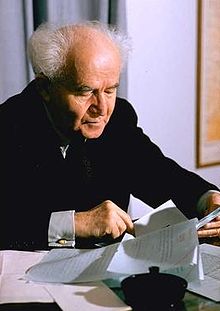
David Ben-Gurion, Israel's first prime minister

Secret Nukes and JFK

Even as it backed down in the Sinai, Israel was involved in another monumental deception, a plan for building its own nuclear arsenal.

In 1956, Israel had concluded an agreement with France to build a nuclear reactor in the Negev desert. Israel also signed a secret agreement with France to build an adjacent plutonium reprocessing plant.

Israel began constructing its nuclear plant in 1958. However, French President Charles de Gaulle was worried about nuclear weapons destabilizing the Middle East and insisted that Israel not develop a nuclear bomb from the plutonium processing plant. Prime Minister Ben-Gurion assured de Gaulle that the processing plant was for peaceful purposes only.

After John F. Kennedy became President, he also wrote to Ben-Gurion explicitly calling on Israel not to join the nuclear-weapons club, drawing another pledge from Ben-Gurion that Israel had no such intention.

Nevertheless, Kennedy continued to press, forcing the Israelis to let U.S. scientists inspect the nuclear reactor at Dimona. But the Israelis first built a fake control room while bricking up and otherwise disguising parts of the building that housed the plutonium processing plant.

In return for allowing inspectors into Dimona, Ben-Gurion also demanded that the United States sell Hawk surface-to-air missiles to the Israeli military. Kennedy agreed to the sale as a show of good faith. Subsequently, however, the CIA got wind of the Dimona deception and leaked to the press that Israel was secretly building a nuclear bomb.

After Kennedy’s assassination, President Lyndon Johnson also grew concerned over Israel’s acquiring nuclear weapons. He asked then-Prime Minister Levi Eshkol to sign the Nuclear Non-Proliferation Treaty.

Eshkol assured Johnson that Israel was studying the matter and would sign the treaty in due course. However, Israel has never signed the treaty and never has admitted that it developed nuclear weapons. [For details, See Israel and The Bomb by Avner Cohen.]

Trapping Johnson

As Israel grew more sophisticated – and more confident – in its dealings with U.S. presidents, it also sought to secure U.S. military assistance by exaggerating its vulnerability to Arab attacks.

One such case occurred after the Egyptians closed off the Gulf of Aqaba to Israel in May 1967, denying the country its only access to the Red Sea. Israel threatened military action against Egypt if it did not re-open the Gulf.

Israel then asked President Johnson for military assistance in the event war broke out against the Egyptians. Johnson directed Richard Helms, the newly appointed head of the CIA to evaluate Israel’s military capability in the event of war against the surrounding Arab states.

On May 26, 1967, Israeli Foreign Minister Abba Eban met with Johnson, Secretary of Defense Robert McNamara, and CIA Director Helms. Eban presented a Mossad estimate of the capability of the Arab armies, claiming that Israel was seriously outgunned by the Arab armies which had been supplied with advanced Soviet weaponry.

Israel believed that, owing to its special relationship with the United States, the Mossad intelligence assessment would be taken at face value.

However, Helms was asked to present the CIA estimate of the Arabs’ military capabilities versus the Israeli army. The CIA’s analysts concluded that Israel could “defend successfully against simultaneous Arab attacks on all fronts, or hold on any three fronts while mounting a successful major offensive on the fourth.” [See “C.I.A. Analysis of the 1967 Arab Israeli War,” Center for the Study of Intelligence.]

“We do not believe that the Israeli appreciation was a serious estimate of the sort they would submit to their own high officials,” the CIA report said. “It is probably a gambit intended to influence the U.S. to provide military supplies, make more public commitments to Israel, to approve Israeli military initiatives, and put more pressure on Egyptian President Nasser.” [See A Look Over My Shoulder by Richard Helms.]

The CIA report stated further that the Soviet Union would probably not interfere militarily on behalf of the Arab states and that Israel would defeat the combined Arab armies in a matter of days.

As a consequence, Johnson refused to airlift special military supplies to Israel, or to promise public support for Israel if Israel went to war.

The Six-Day Success

Despite Johnson’s resistance, Israel launched an attack on its Arab neighbors on June 5, 1967, claiming that the conflict was provoked when Egyptian forces opened fire. (The CIA later concluded that it was Israel that had first fired upon Egyptian forces.)

On June 8, at the height of the conflict, which would become known as the Six-Day War, Israeli fighter/bombers attacked the USS Liberty, a lightly armed communications vessel sent on a mission to relay information on the course of the war to U.S. naval intelligence.

The attack killed 34 Americans sailors, and wounded 171 others. Israeli leaders have always claimed that they had mistaken the U.S. vessel for an enemy ship, but a number of U.S. officials, including Secretary of State Dean Rusk, believed the attack was deliberate, possibly to prevent the United States from learning about Israel’s war plans. [See As I Saw It by Dean Rusk.]

However, in deference to Israel, the U.S. government did not aggressively pursue the matter of the Liberty attack and even issued misleading accounts in medal citations to crew members, leaving out the identity of the attackers.

Meanwhile, on land and in the air, Israel’s powerful military advanced, shredding the Arab defenses. Soon, the conflict escalated into another potential showdown between nuclear-armed superpowers, the Soviet Union and the United States.

On June 10, President Johnson received a “Hot Line” message from Soviet Premier Alexi Kosygin. The Kremlin warned of grave consequences if Israel continued its military campaign against Syria by entering and/or occupying that country.

Johnson dispatched the Sixth Fleet to the Mediterranean, in a move to convince the Soviets of American resolve. But a ceasefire was declared later the same day, with Israel ending up in control of Syria’s Golan Heights, Egypt’s Sinai, and Palestinian lands including Gaza and East Jerusalem.

But a wider war was averted. Johnson’s suspicions about Israel’s expansionist intent had kept the United States from making an even bigger commitment that might have led to the Soviets countering with an escalation of their own.

Nixon and Yom Kippur

Israeli occupation of those additional Arab lands set the stage for a resumption of hostilities six years later, on Oct. 6, 1973, with the Yom Kippur War, which began with a surprise attack by Egypt against Israeli forces in the Sinai.

The offensive caught Israel off guard and Arab forces were close to overrunning Israel’s outer defenses and entering the country. According to later accounts based primarily on Israeli leaks, Prime Minister Golda Meir and her “kitchen cabinet” ordered the arming of 13 nuclear weapons, which were aimed at Egyptian and Syrian targets.

Israeli Ambassador to the United States Simha Dintz warned President Richard Nixon that very serious repercussions would occur if the United States did not immediately begin an airlift of military equipment and personnel to Israel.

Fearing that the Soviet Union might intervene and that nuclear war was possible, the U.S. military raised its alert level to DEFCON-3. U.S. Airborne units in Italy were put on full alert, and military aid was rushed to Israel.

Faced with a well-supplied Israeli counteroffensive and possible nuclear annihilation, the Arab forces fell back. The war ended on Oct. 26, 1973, but the United States had again been pushed to the brink of a possible superpower confrontation due to the unresolved Israeli-Arab conflict.

Nuclear ‘Ambiguity’

On Sept. 22, 1979, after some clouds unexpectedly broke over the South Indian Ocean, a U.S. intelligence satellite detected two bright flashes of light that were quickly interpreted as evidence of a nuclear test.

The explosion was apparently one of several nuclear tests that Israel had undertaken in collaboration with the white-supremacist government of South Africa. But President Jimmy Carter – at the start of his reelection bid – didn’t want a showdown with Israel, especially on a point as sensitive as its secret nuclear work with the pariah government in Pretoria.

So, after news of the nuclear test leaked a month later, the Carter administration followed Israel’s longstanding policy of “ambiguity” about the existence of its nuclear arsenal, a charade dating back to Richard Nixon’s presidency with the United States pretending not to know for sure that Israel possessed nuclear bombs.

The Carter administration quickly claimed that there was “no confirmation” of a nuclear test, and a panel was set up to conclude that the flashes were “probably not from a nuclear explosion.”

However, as investigative reporter Seymour Hersh and various nuclear experts later concluded, the flashes were most certainly an explosion of a low-yield nuclear weapon. [For details, see Hersh’s Samson Option.]

Getting Carter

Despite Carter’s helpful cover-up of the Israeli-South African nuclear test, he was still viewed with disdain by Israel’s hard-line Likud leadership. Indeed, he arguably was the target of Israel’s most audacious intervention in U.S. politics.

Prime Minister Menachem Begin was furious at Carter over the 1978 Camp David accords in which the U.S. President pushed the Israelis into returning the Sinai to the Egyptians in exchange for a peace agreement.

The next year, Carter failed to protect the Shah of Iran, an important Israeli regional ally who was forced from power by Islamic militants. Then, when Carter acceded to demands from the Shah’s supporters to admit him to New York for cancer treatment, Iranian radicals seized the U.S. Embassy in Tehran and held 52 Americans hostage.

In 1980, as Carter focused on his reelection campaign, Begin saw both dangers and opportunities. High-ranking Israeli diplomat/spy David Kimche described Begin’s thinking in the 1991 book, The Last Option, recounting how Begin feared that Carter might force Israel to withdraw from the West Bank and accept a Palestinian state if he won a second term.

“Begin was being set up for diplomatic slaughter by the master butchers in Washington,” Kimche wrote. “They had, moreover, the apparent blessing of the two presidents, Carter and [Egyptian President Anwar] Sadat, for this bizarre and clumsy attempt at collusion designed to force Israel to abandon her refusal to withdraw from territories occupied in 1967, including Jerusalem, and to agree to the establishment of a Palestinian state.”

Begin’s alarm was driven by the prospect of Carter being freed from the pressure of having to face another election, according to Kimche.

“Unbeknownst to the Israeli negotiators, the Egyptians held an ace up their sleeves, and they were waiting to play it,” Kimche wrote. “The card was President Carter’s tacit agreement that after the American presidential elections in November 1980, when Carter expected to be re-elected for a second term, he would be free to compel Israel to accept a settlement of the Palestinian problem on his and Egyptian terms, without having to fear the backlash of the American Jewish lobby.”

So, by spring 1980, Begin had privately sided with Carter’s Republican rival, Ronald Reagan, a reality that Carter soon realized.

Questioned by congressional investigators in 1992 regarding allegations about Israel conspiring with Republicans in 1980 to help unseat him, Carter said he knew by April 1980 that “Israel cast their lot with Reagan,” according to notes found among the unpublished documents in the files of a House task force that looked into the so-called October Surprise case.

Carter traced the Israeli opposition to his reelection to a “lingering concern [among] Jewish leaders that I was too friendly with Arabs.”

Doing What Was Necessary

Begin was an Israeli leader committed to do whatever he felt necessary to advance Israeli security interests and the dream of a Greater Israel with Jews controlling the ancient Biblical lands. Before Israel’s independence in 1948, he had led a Zionist terrorist group, and he founded the right-wing Likud Party in 1973 with the goal of “changing the facts on the ground” by placing Jewish settlements in Palestinian areas.

Begin’s anger over the Sinai deal and his fear of Carter’s reelection set the stage for secret collaboration between Begin and the Republicans, according to another former Israeli intelligence official, Ari Ben-Menashe.

“Begin loathed Carter for the peace agreement forced upon him at Camp David,” Ben-Menashe wrote in his 1992 memoir, Profits of War. “As Begin saw it, the agreement took away Sinai from Israel, did not create a comprehensive peace, and left the Palestinian issue hanging on Israel’s back.”

Ben-Menashe, an Iranian-born Jew who had immigrated to Israel as a teen-ager, became part of a secret Israeli program to reestablish its Iranian intelligence network that had been decimated by the Islamic revolution. Ben-Menashe wrote that Begin authorized shipments to Iran of small arms and some military spare parts, via South Africa, as early as September 1979 and continued them despite Iran’s seizure of the U.S. hostages in November 1979.

Extensive evidence also exists that Begin’s preference for Reagan led the Israelis to join in a covert operation with Republicans to contact Iranian leaders behind Carter’s back, interfering with the President’s efforts to free the 52 American hostages before the November 1980 elections.

That evidence includes statements from senior Iranian officials, international arms dealers, intelligence operatives, and Middle East political figures (including a cryptic confirmation from Begin’s successor Yitzhak Shamir). But the truth about the October Surprise case remains in dispute to this day. [For details, see Robert Parry’s Secrecy & Privilege.]

It is clear that after Reagan defeated Carter — and the U.S. hostages were released immediately upon Reagan being sworn in on Jan. 20, 1981 — Israeli-brokered weapons shipments flowed to Iran with the secret blessing of the new Republican administration.

Dealing with Reagan

The Israel Lobby had grown exponentially since its start in the Eisenhower years. Israel’s influential supporters were now positioned to use every political device imaginable to lobby Congress and to get the White House to acquiesce to whatever Israel felt it needed.

President Reagan also credentialed into the Executive Branch a new group of pro-Israeli American officials – the likes of Elliott Abrams, Richard Perle, Michael Ledeen and Jeane Kirkpatrick – who became known as the neocons.

Yet, despite Reagan’s pro-Israel policies, the new U.S. President wasn’t immune from more Israeli deceptions and additional pressures.

Indeed, whether because of the alleged collusion with Reagan during the 1980 campaign or because Israel sensed its greater clout within his administration, Begin demonstrated a new level of audacity.

In 1981, Israel recruited Jonathan Pollard, an American Navy intelligence analyst, as a spy to acquire American intelligence satellite photos. Eventually, Pollard purloined massive amounts of intelligence information, some of which was reportedly turned over to Soviet intelligence by Israel to win favors from Moscow.

Prime Minister Begin sensed, too, that the time was ripe to gain the upper hand on other Arab enemies. He turned his attention to Lebanon, where the Palestine Liberation Organization was based.

Lebanon War

When U.S. intelligence warned Reagan that Israel was massing troops along the border with Lebanon, Reagan sent a cable to Begin urging him not to invade. But Begin ignored Reagan’s plea and invaded Lebanon the following day, on June 6, 1982. [See Time, Aug. 16, 1982.]

As the offensive progressed, Reagan sought a cessation of hostilities between Israel and the PLO, but Israel was intent on killing as many PLO fighters as possible. Periodic U.S.-brokered ceasefires failed as Israel used the slightest provocation to resume fighting, supposedly in self-defense.

“When PLO sniper fire is followed by fourteen hours of Israeli bombardment that is stretching the definition of defensive action too far,” complained Reagan, who kept the picture of a horribly burned Lebanese child on his desk in the Oval Office as a reminder of the tragedy of Lebanon.

The American public nightly witnessed the Israeli bombardment of Beirut on television news broadcasts. The pictures of dead, mutilated children caught in the Israeli artillery barrages, were particularly wrenching. Repulsed by the carnage, the U.S. public decidedly favored forcing Israel to stop.

When Reagan warned Israel of possible sanctions if its forces continued to indiscriminately attack Beirut, Israel launched a major offensive against West Beirut the next day.

In the United States, Israeli supporters demanded a meeting with Reagan to press Israel’s case. Though Reagan declined the meeting, one was set up for 40 leaders of various Jewish organizations with Vice President George H.W. Bush, Defense Secretary Caspar Weinberger and Secretary of State George Shultz.

Reagan wrote once again to Begin, reminding him that Israel was allowed to use American weapons only for defensive purposes. He appealed to Begin’s humanitarianism to stop the bombardment.

The next day, in a meeting with Israeli supporters from the United States, Begin fumed that he would not be instructed by an American president or any other U.S. official.

“Nobody is going to bring Israel to her knees. You must have forgotten that Jews do not kneel but to God,” Begin said. “Nobody is going to preach to us humanitarianism.”

Begin’s government also used the tragedy in Lebanon as an opportunity to provide special favors for its American backers.

In From Beirut to Jerusalem, New York Times correspondent Thomas L. Freidman wrote that the Israeli Army conducted tours of the battlefront for influential U.S. donors. On one occasion, women from Hadassah were taken to the hills surrounding Beirut and were invited to look down on the city as Israeli artillery put on a display for them.

The artillery began an enormous barrage, with shells landing throughout the densely populated city. The shells struck and destroyed apartments, shops, homes and shacks